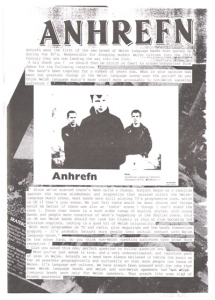
 Anhrefn were the first of the new breed of Welsh language bands that sprung up during the 80’s. Responsible for dragging modern Welsh culture into the 20th century, they are now leading the way into the 21st.
A big thank you to singer / song-writer Sion Sebon for the following interview.
The band’s been together for a number of years now, what in your opinion has been the greatest change in the Welsh language scene over the period? Do you think the music’s made itself more accessible to non-Welsh speaking audiences?
“Since we started there’s been quite a change. Anhrefn began as a reaction against the narrow mindedness and stagnation that existed within the Welsh language music scene; most bands were still playing 70’s progressive rock – which is OK if that’s your scene. We just felt there would be more choice and things would be better if there was also an ‘indie’ scene –although I can’t stand the term.
“Since then there’s a much wider range of musical styles, with young bands and people more conscious of what’s happening in the English scene. This is OK but Welsh bands should not look too closely at this or risk becoming third division copyists, lacking in a good bit of Welsh originality.
“With more programmes on TV and radio, plus magazines and the bands themselves gigging; it’s probably brought more people into initial contact with Welsh language bands.”
On the other hand, do you think non-Welsh speaking audiences have grown more receptive?
“Glad you asked this one, perfect question to follow on from the first.
“What you’ve asked is true, and a very underestimated, important part of gigs in Wales. Anhrefn as a band have always believed in taking music as far as possible geographically and culturally, so that more people can learn of Wales, its language and culture. We have always been annoyed with the idea that some Welsh language bands and Welsh and non-Welsh speakers had that Welsh language bands were only for Welsh speakers. That sounds like some sort of bloody apartheid!
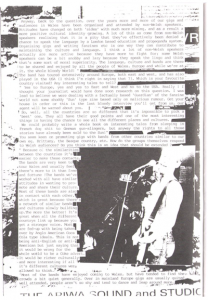 “Anyway, back to the question, over the years more and more of our gigs and audiences in Wales have been organised and attended by non-Welsh speakers. Attitudes have changed on ‘both’ sides with much more mixing, and as a result a more positive cultural identity growing. A lot of this as come from non-Welsh speaking releasing that it is a pity that they’re effectively been denied a chance to speak the language by a London-based education and propaganda system.
“Organised gigs and writing fanzines is one way they can contribute to maintaining the culture and language. I think a lot of non-Welsh speakers actually are more active because they have more to fight for; some Welsh speakers can be a bit snobby and lazy because they speak the lingo and think that’s some sort of moral superiority. The language, culture and bands are there to be shared and enjoyed by all the people of Wales, Europe and while we’re at it, the whole bloody world!”
The band has toured extensively around Europe, both east and west. What is your favourite country out of those you’ve visited? Have you any interesting tales to tell?
“All the countries are so different that it’s impossible to pick a ‘best’ one. They all have their good points and one of the most interesting things is having the chance to see all the different places and cultures.
“We could probably write a whole book on interesting tales from sleeping in French dog shit to German gun-slingers, but the rights to all those stories have already been sold The Sun!”
You seem keen on promoting gigs with bands from other countries similar to our own e.g. Brittany, the Basque Country, etc. How do the groups themselves respond to Welsh audiences? Do you think it’s an idea that should be expanded?
“Because of the similarities between the countries it’s easier to make those contacts. The bands are very keen to tour Wales and usually feel there’s more to it than fame and fortune. The bands we’ve worked with all have similar attitudes in wanting to promote and share their culture. Most of the bands are in contact with each other, which is great, as there’s now a network of similar bands and cultures slowly building up. The more the better!
“It’s great when all the different countries link up because you get a stronger voice. Most are fed up with being taken over by Anglo-American Coca Cola type ideals. This is not being anti-English or anti-American but just saying that it would be wrong for the whole world to be a Coca Cola advert. It would be richer culturally and more interesting if all its different cultures were allowed to think.
“Most of the bands have enjoyed coming to Wales, but have tended to find the crowds a bit quiet generally. Over in mainland Europe, gigs are usually quite well attended, people aren’t so shy and tend to dance and leap around more.
“The bands always worry that people don’t like them if the audience isn’t dancing, so we usually explain that Welsh people can’t dance because of a genetic fault! Anyway dancing and shouting isn’t everything and the bands have usually been overwhelmed by the welcome they get in general during and outside the time when they are at a gig.”
 You recently toured Czechoslovakia. What was it like to be in a state that was on the verge of splitting?
“We’ve toured Czechoslovakia twice now. Both times we became aware that there were three areas to it, Bohemia (roughly north), Moravia (central) and Slovacia (south east). However, at this time there was no talk of splitting the country (Bohemia and Moravia making up the new Czech Republic). Even now the split isn’t very clear – it seems to be into two republics. It seems like a good idea, like it would be for Wales to be decentralised from London. As in Czechoslovakia, the two areas have different economic needs and problems; in Wales we also have a cultural difference.
“These changes should hopefully be a positive move getting rid of any old ill-feeling and enabling different republics to build up new, better and friendlier ties with their neighbours, where differences are respected and not frowned upon.
“We’re off to Czechoslovakia again this year, so maybe in the next interview we can give you a better view on what it’s like. It should be very interesting, as in the past the Czech people have been great in organisation and welcome, and possibly have the best beer in Europe!”
What are the short and long terms plans of the bands?
“At the moment we’re rehearsing new songs, and will begin work on a new album before the end of the year. It’ll probably take about six months to finish it completely, so there could be a cassette single release in the meantime.
“We have a tour of Germany and Czechoslovakia coming up and some gigs around Wales and England, mainly to promote the video and to hopefully sell the remaining copies of ‘Dragon’s Revenge’.
“Next year the main thing will be to finish the new album and then start all over gain on touring, etc, to promote and sell it!”
Interview by Darren Jones